🎲 AI Battle Arena
Why benchmark strategic interaction?
Static benchmarks wear out
- Saturate as models improve
- Leak into training data (contamination)
- Gameable; reward recall over decision-making
Strategic interaction gives a renewable skill signal
- Interactive → difficulty regenerates with the opponent
- Demand hidden-info reasoning + long-horizon planning
- Produce a natural, relative ranking
One pipeline, many environments
- One pipeline · many environments — same prompt / parse / retry / scoring everywhere
- Position-neutral, opponent-adjusted — round-robin, seat-swapped, bootstrap Elo with error bars
- Logs that explain — every step logged → why-win / why-lose, not just a number
- Agents, not models — agents see only observations, never hidden state → private information stays private
| Environment | Info |
|---|---|
| Kuhn Poker | imperfect |
| Leduc Hold'em | imperfect |
| Hold'em 1-Hand | imperfect |
| Hold'em Match | imperfect |
| Blackjack (vs dealer) | imperfect |
| Connect Four | perfect |
| Gomoku-Lite | perfect |
| Colonel Blotto | simultaneous |
What we'll cover today
🤖 Model Arena — raw models, one simple prompt
- Two strategic-interaction families: perfect-info (Connect Four · Gomoku) and hidden-info (Hold'em family · Leduc · Kuhn · Blotto · Blackjack)
- The rankings — who wins, and who wins where
- The findings — diagonal blind spot · pressure-vs-showdown · why models win & lose
🛠️ Harness Arena — beyond the raw model
- Preliminary: what kind of harness / pipeline helps a model act more strategically
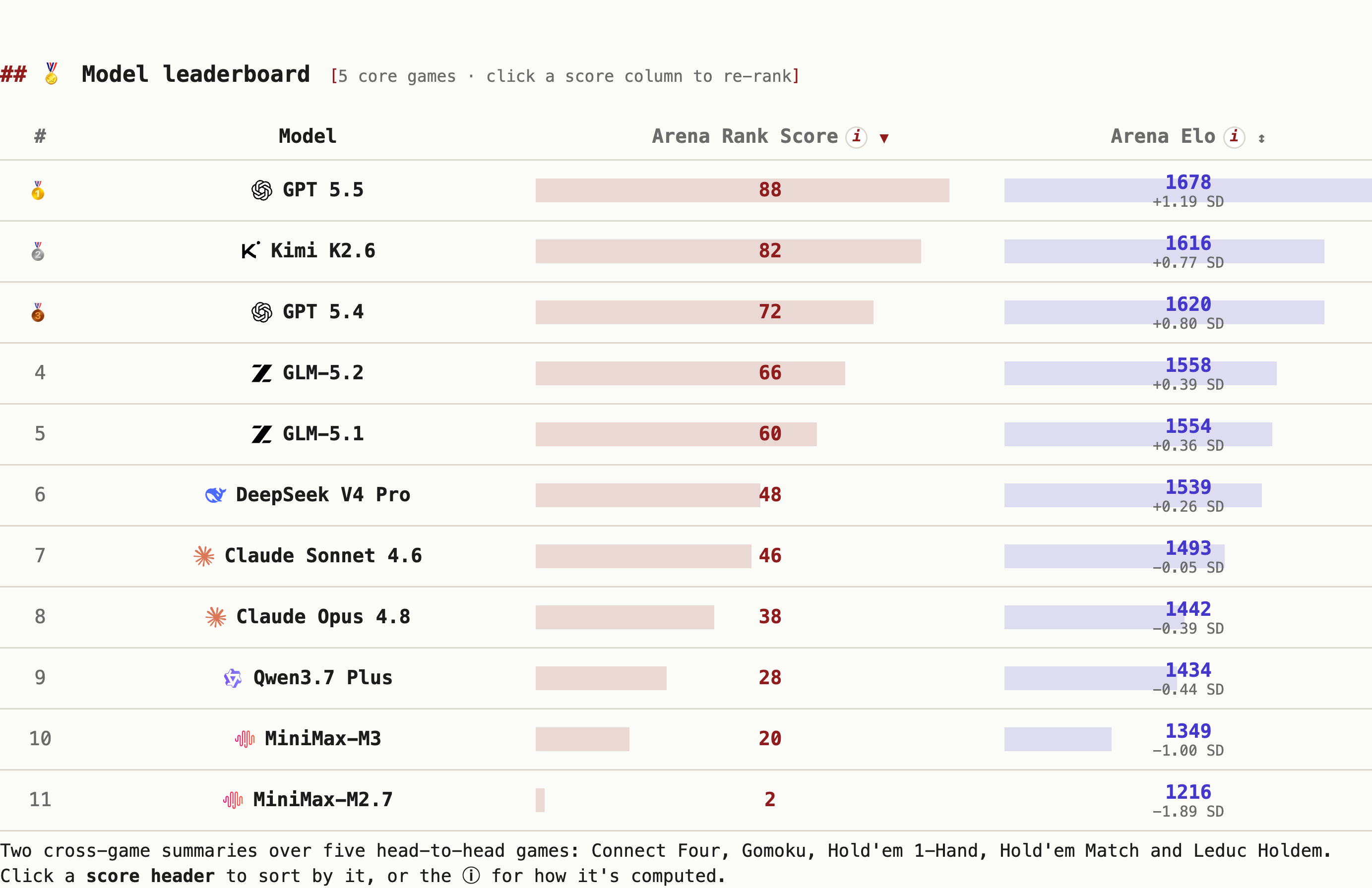
The cross-environment leaderboard
Case study
Three environments up close. For each: the ranking first, then two slices of behavior — and a replay to watch it happen.
Gomoku — do they spot & block threats?
Hold'em 1-Hand — how chips are earned: pressure vs showdown
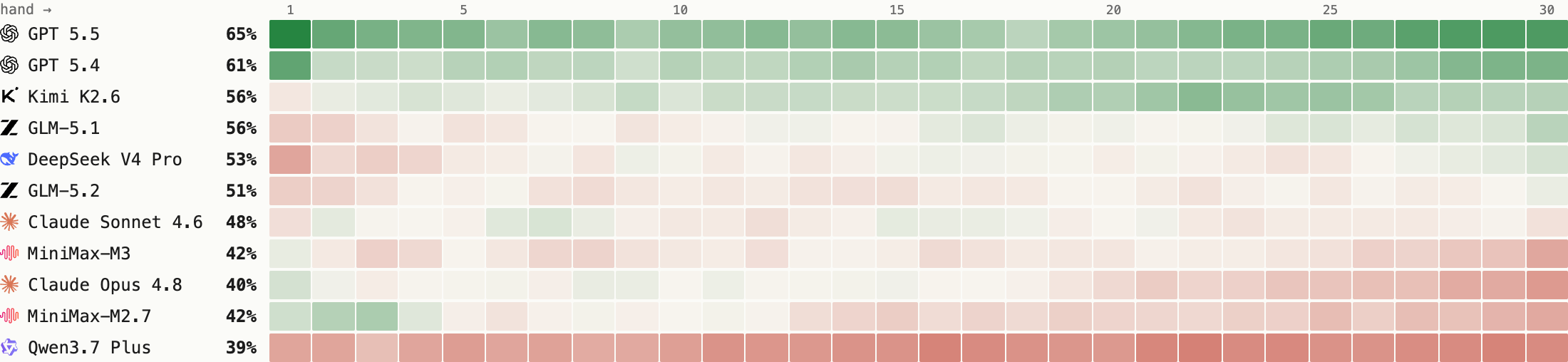
Hold'em Match — chip management over 30 hands
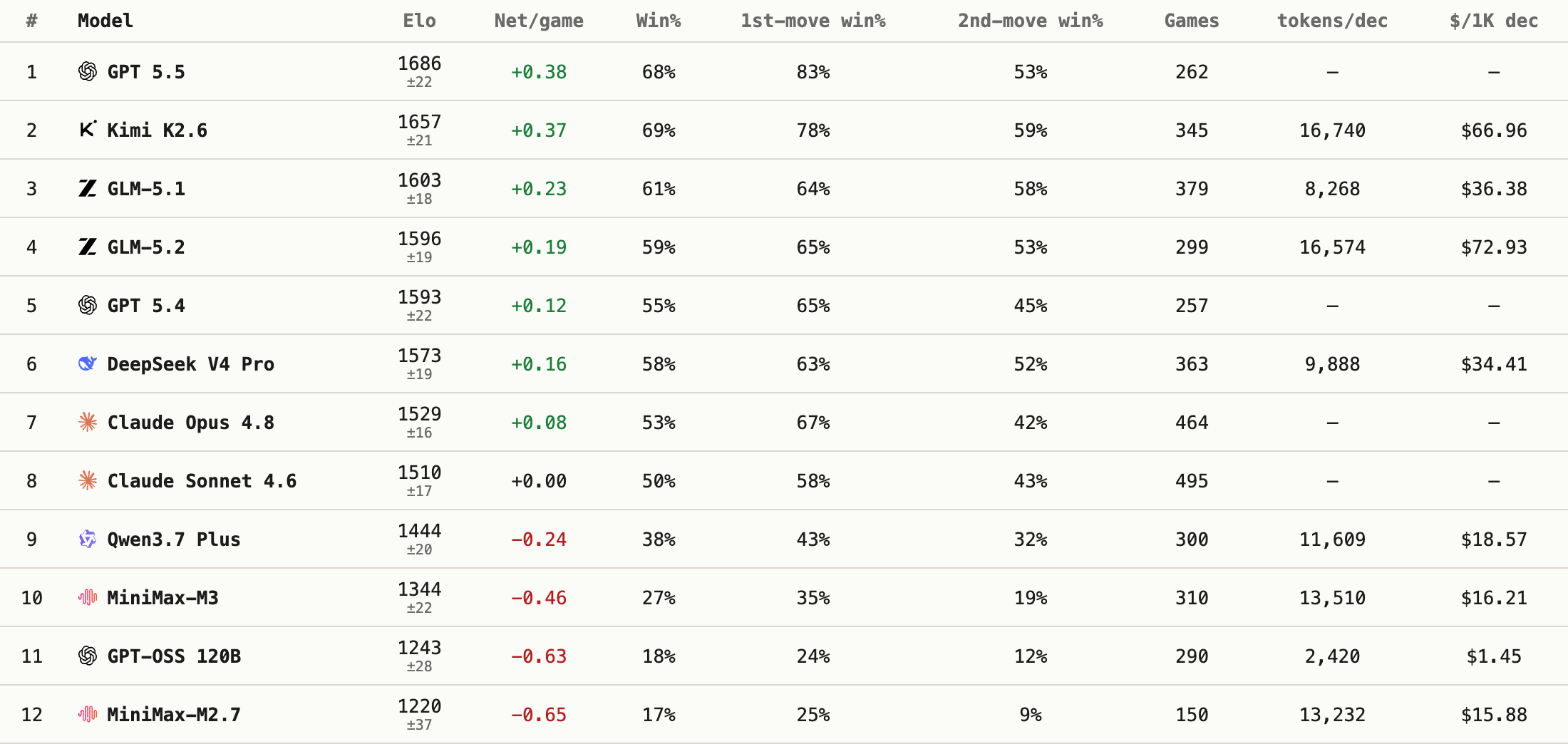
Gomoku — the ranking
Offense is solved — defense decides
| model | win% | win-take% | block% | late-game error % |
|---|---|---|---|---|
| Kimi K2.6 | 69 | 100 | 75 | 23 |
| GPT 5.5 | 68 | 99 | 80 | 22 |
| GLM-5.1 | 61 | 94 | 68 | 32 |
| GLM-5.2 | 59 | 96 | 67 | 33 |
| DeepSeek V4 Pro | 58 | 98 | 68 | 32 |
| GPT 5.4 | 55 | 99 | 73 | 33 |
| Claude Opus 4.8 | 53 | 92 | 67 | 38 |
| Claude Sonnet 4.6 | 50 | 98 | 65 | 40 |
| Qwen3.7 Plus | 38 | 93 | 60 | 49 |
| MiniMax-M3 | 27 | 89 | 50 | 61 |
| GPT-OSS 120B | 18 | 87 | 43 | 68 |
| MiniMax-M2.7 | 17 | 90 | 47 | 70 |
The blind spot is on the diagonal
| threat axis | faced | missed | miss-rate |
|---|---|---|---|
| horizontal (contiguous in text) | 428 | 24 | 5.6% |
| vertical (strided across rows) | 401 | 49 | 12.2% |
| diagonal ↘ (down-right) | 284 | 43 | 15.1% |
| diagonal ↙ (down-left) | 231 | 56 | 24.2% |
Hold'em 1-Hand — the ranking
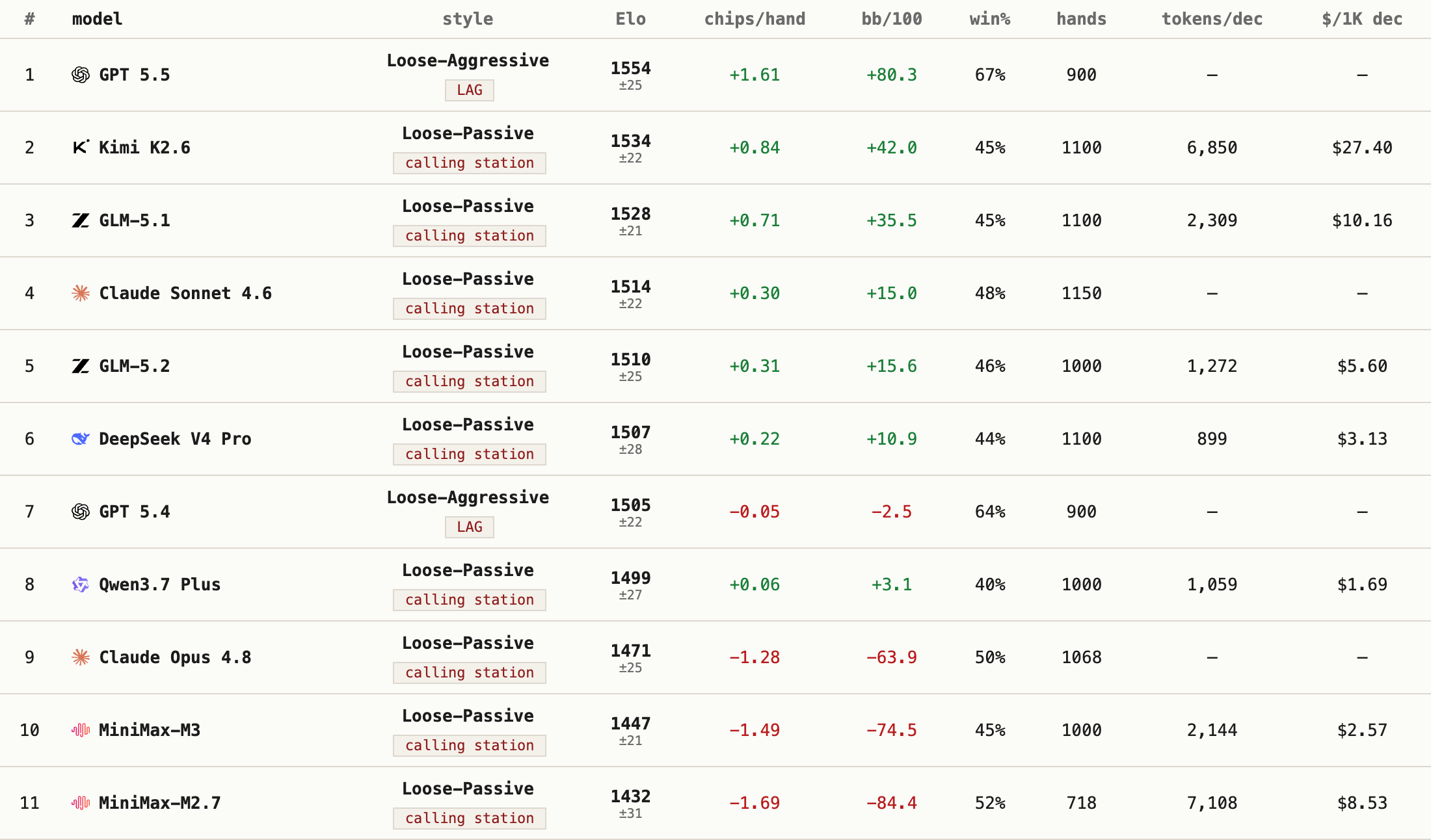
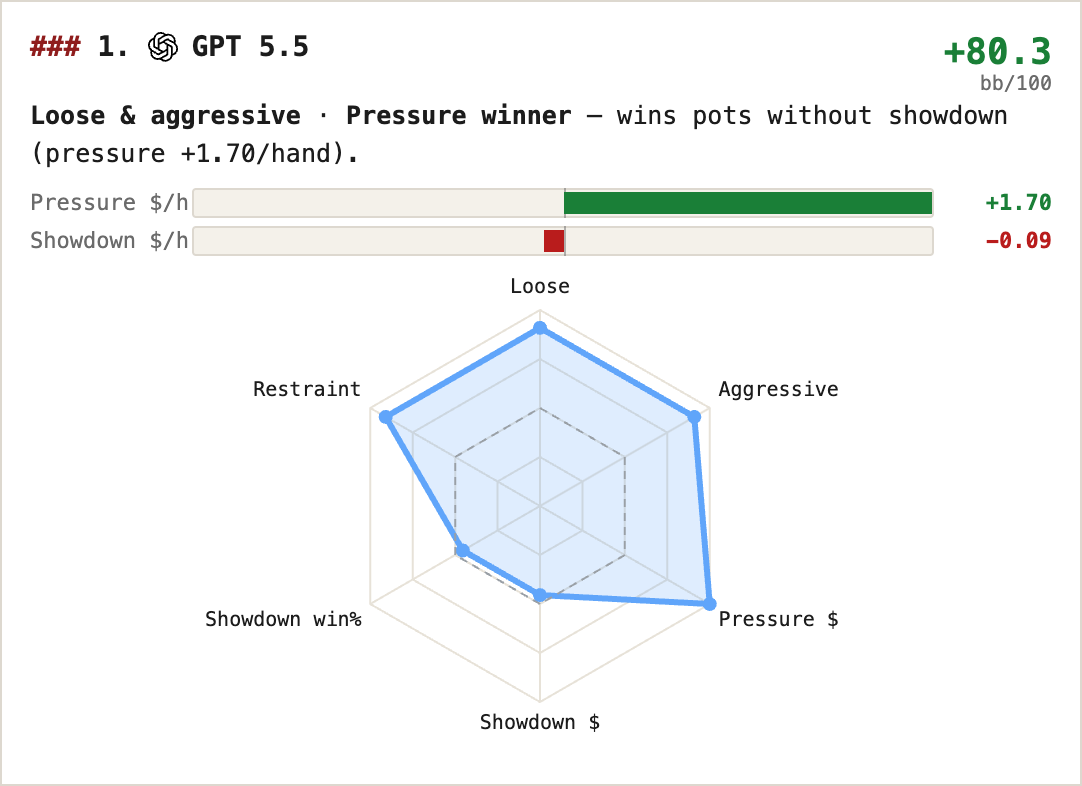
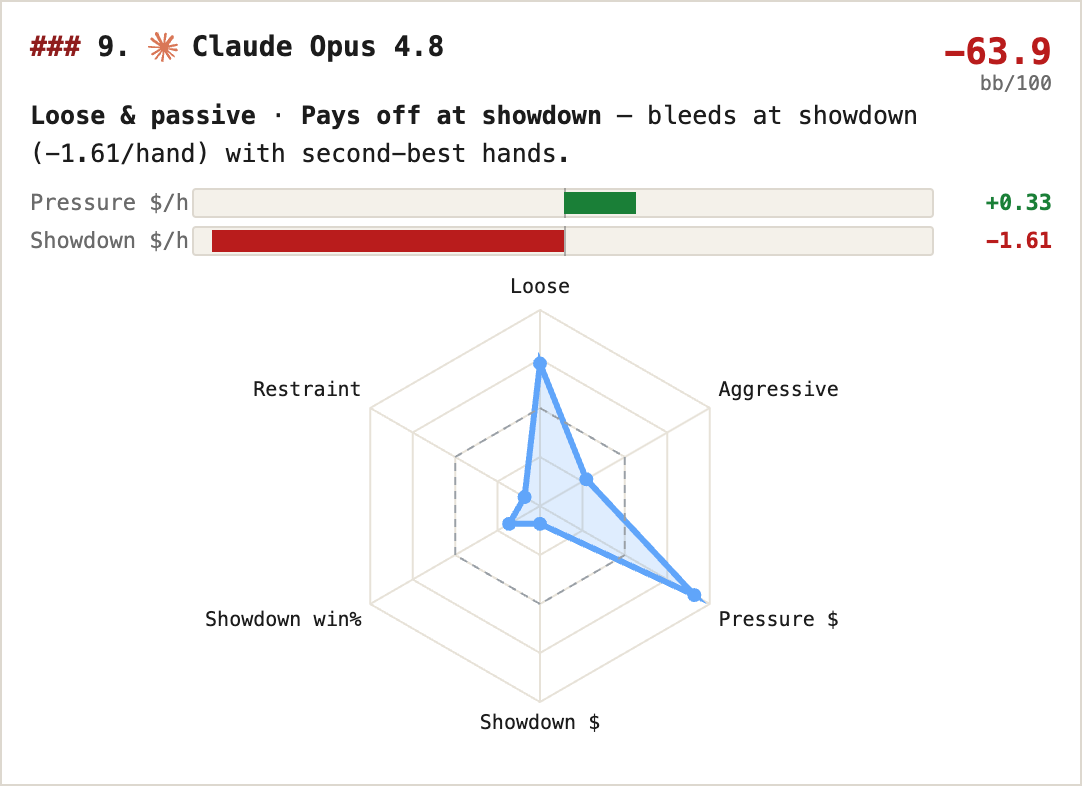
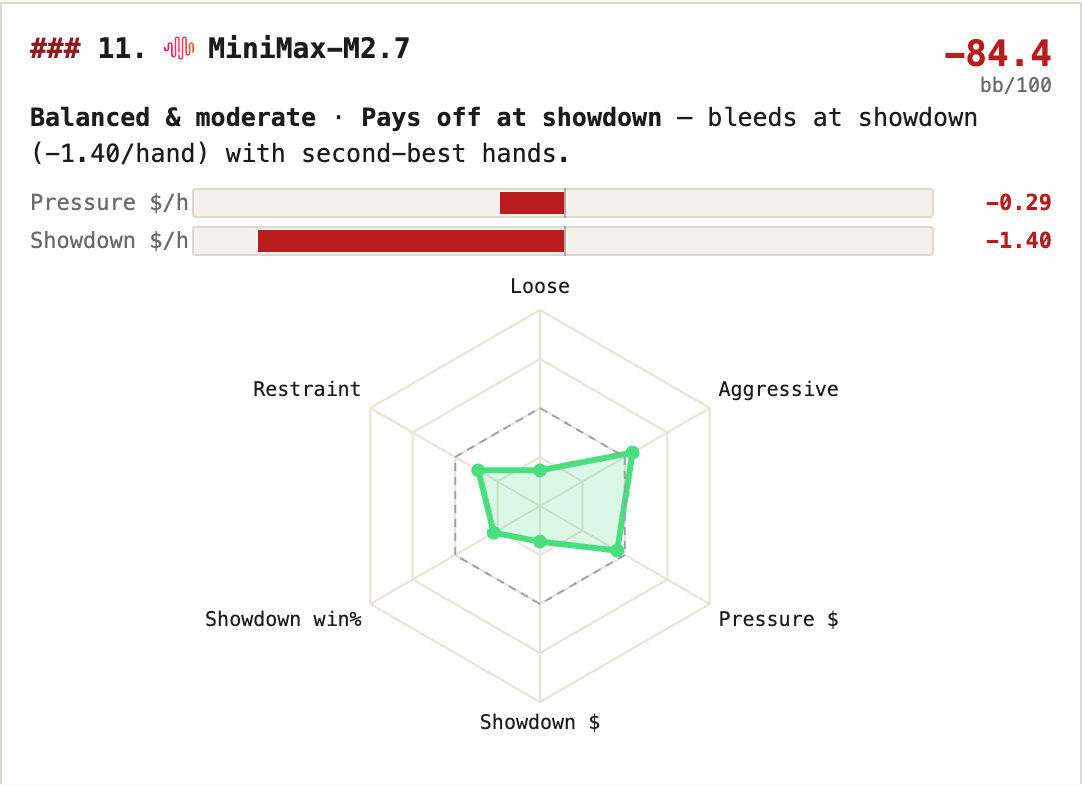
Where the chips come from
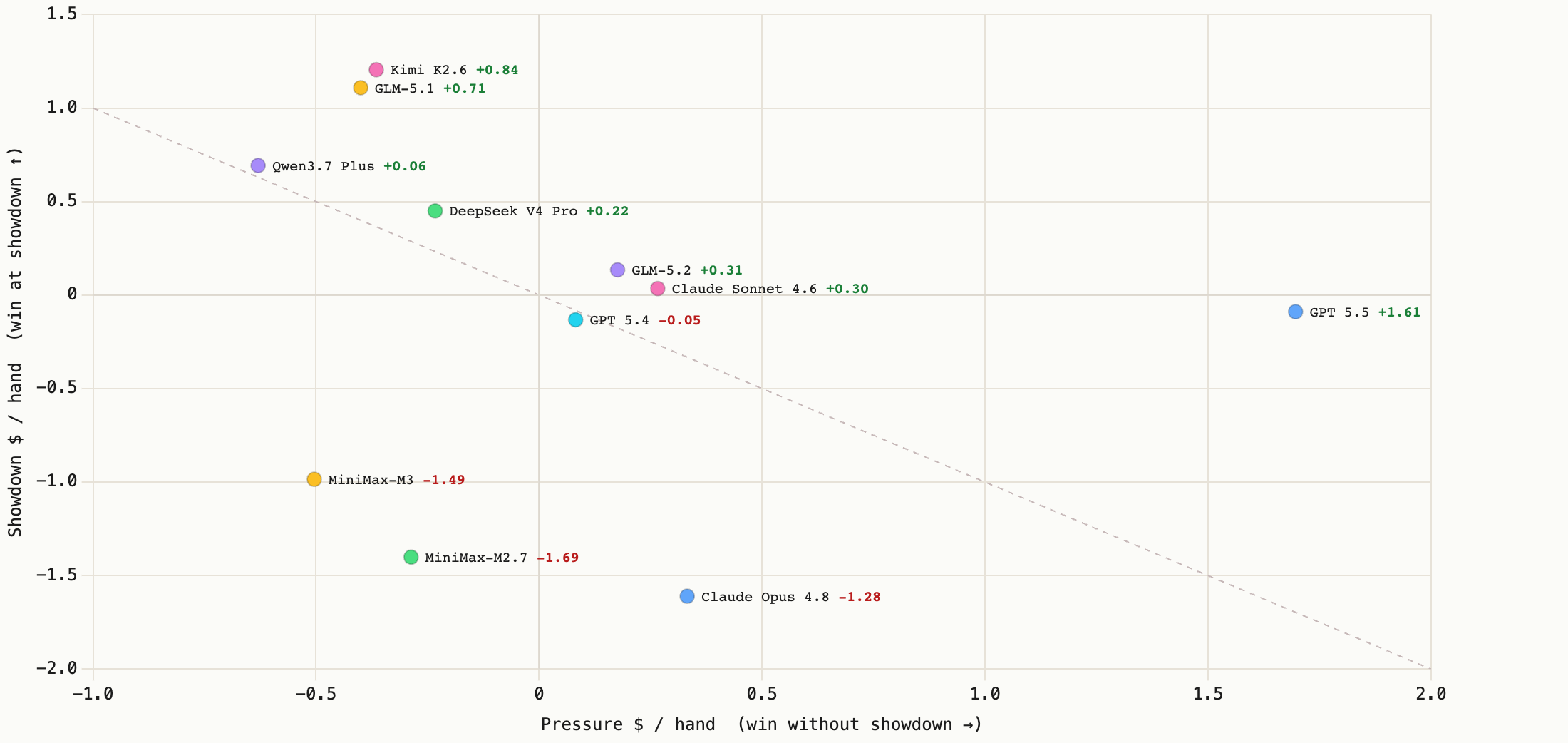
- Pressure $ — won without showdown (folding opponents out) · Showdown $ — won at showdown (hand strength)
- Winners earn by pressure — fold equity (GPT 5.5, far right); losers bleed at showdown — pay off second-best (bottom)
Style & mistakes: three models compared
Hold'em Match — the ranking
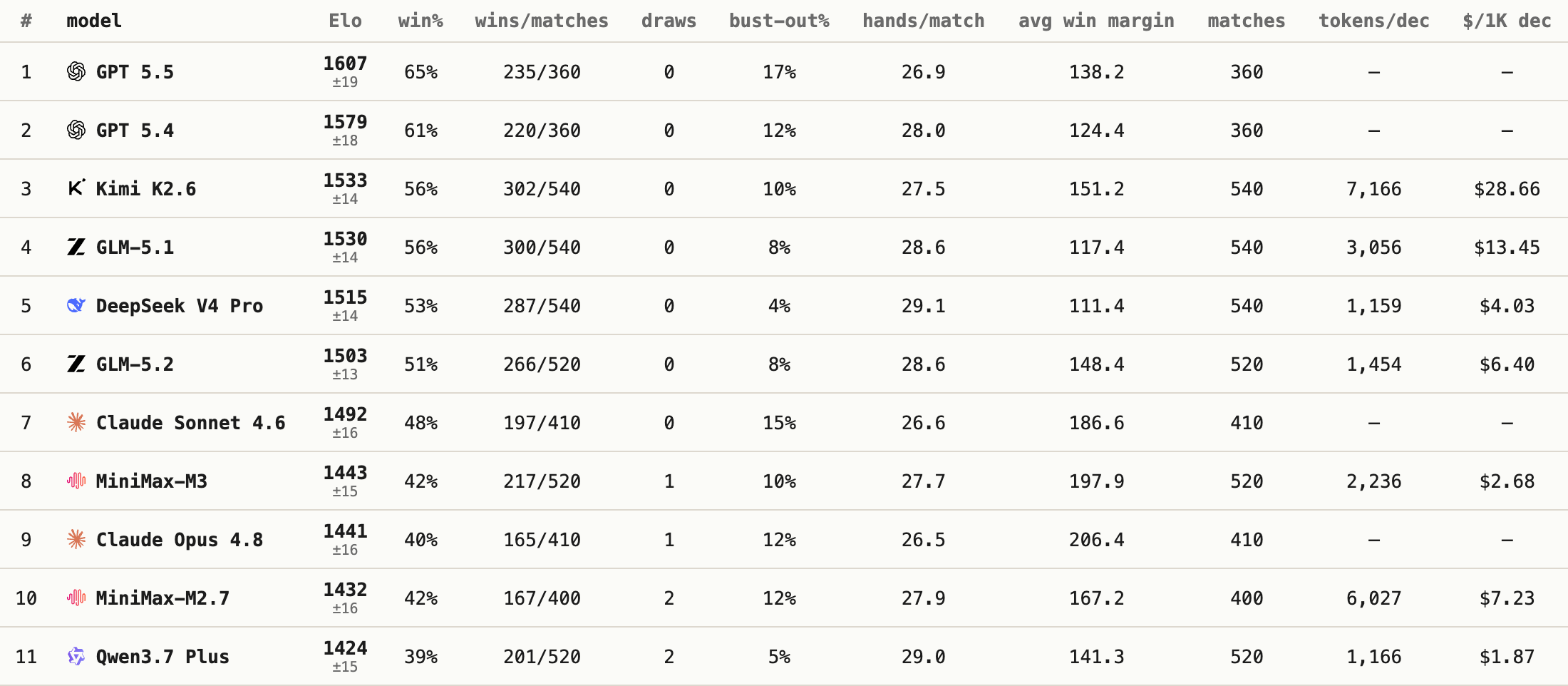
The match-only skill: shift gears with the score
Only across 30 carry-stack hands can a model read ahead vs behind and adapt — a single hand can't show it. Winners fight back when behind (aggression ↑, fold less); flat players get ground down.
| model | aggression ahead→behind | gear-shift Δ | bust-out% | match win% |
|---|---|---|---|---|
| GPT 5.5 | 34% → 51% | +17 | 17% | 65% |
| GPT 5.4 | 31% → 52% | +21 | 12% | 61% |
| GLM-5.1 | 20% → 32% | +12 | 8% | 56% |
| Claude Opus 4.8 | 25% → 25% | 0 | 12% | 40% |
| Qwen3.7 Plus | 14% → 16% | +2 | 5% | 39% |
Short-stacked: gamble, don't freeze
When a model is short-stacked (about to lose the match), the correct play is to push — take a shot at a comeback, because playing it safe loses anyway. Aggression bucketed by effective stack:
| model | deep ≥40bb | mid 15–40bb | short <15bb |
|---|---|---|---|
| GPT 5.5 | 40% | 37% | 86%* |
| GPT 5.4 | 40% | 32% | 24% |
| Kimi K2.6 | 33% | 24% | 30% |
| GLM-5.1 | 27% | 25% | 50%* |
| DeepSeek V4 Pro | 28% | 21% | 46%* |
| GLM-5.2 | 28% | 26% | 18% |
| Claude Sonnet 4.6 | 31% | 24% | 11% |
| MiniMax-M3 | 28% | 22% | 35% |
| Claude Opus 4.8 | 26% | 18% | 6% |
| MiniMax-M2.7 | 34% | 35% | 33% |
| Qwen3.7 Plus | 15% | 12% | 0%* |
The single-hand skill mostly transfers
Today we measure the model out of the box
- Current results: a single simple system prompt, each model plays independently → a score
- That measures the model as-is — not its ceiling
- Scaffolding, tools, search, or training on strategic-interaction logs could move it a lot
- (cf. the "Harness Arena": are we measuring the model, or the scaffolding?)
system prompt
New axis: the pipeline, not just the model
- Research question: how much does the pipeline move performance?
- Variants: richer prompts · tools/search · self-play · SFT / RL on interaction logs
- The arena stays the fixed measuring stick across all variants
same ruler
Four pipelines vs the raw model
| pipeline (same model + inference-time scaffold) | glm-5.2 | deepseek-v4 | kimi-k2p6 |
|---|---|---|---|
| aggression_default — bias toward betting | 65% | 63% | 68% |
| council — multi-view synthesis | 73% | 75% | 82% |
| best_of_3 — sample & select | 61% | 58% | 61% |
| self_refine — draft & critique | 70% | 52% | 57% |
win-rate head-to-head vs the plain baseline (model + one plain system prompt) · 50% = tie with plain · n = 28–458 hands per cell
- All four beat the raw model — a scaffold alone, no training, lifts 1-hand win-rate
- Cheapest & robust: aggression_default = one instruction at 1 call → 63–68% everywhere. Strongest: council (multi-view) → 73–82%, but 4 calls
- More calls ≠ automatic win: best_of_3 modest; self_refine model-dependent (strong on glm, ~tie elsewhere)
aggression_default — bias toward betting
- Add one instruction to the prompt (still 1 model call):
- "Default to aggression when unclear — a bet/raise wins two ways (value and fold equity); a call only wins when ahead."
- "Prefer betting/raising over a passive call unless there's a clear reason."
- Idea: LLMs play systematically too passively — one nudge corrects the bias
- The cheapest scaffold here — no extra calls
| vs plain | win% |
|---|---|
| glm-5.2 | 65% |
| deepseek-v4 | 63% |
| kimi-k2p6 | 68% |
1 model call / decision
council — multi-view synthesis
- Ask the same model for the best action from 3 expert viewpoints (separate calls, no decision yet):
- aggressive — maximize pressure & fold equity
- value — extract/protect, avoid spew
- unexploitable — keep a balanced, hard-to-exploit range
- A 4th call synthesizes the three views into one action
- Idea: a single pass has blind spots — force opposing perspectives, then converge
| vs plain | win% |
|---|---|
| glm-5.2 | 73% |
| deepseek-v4 | 75% |
| kimi-k2p6 | 82% |
4 model calls / decision
best_of_3 — sample & select
- Generate 3 candidate actions with different leanings:
- neutral (the obvious line)
- "consider a more aggressive line"
- "consider a more cautious / pot-control line"
- Then select the best of the three
- Selection lever, not critique: pick among finished answers rather than re-thinking
| vs plain | win% |
|---|---|
| glm-5.2 | 61% |
| deepseek-v4 | 58% |
| kimi-k2p6 | 61% |
4 model calls / decision
self_refine — draft & critique
- Draft an action with reasoning
- Self-critique it: "is this the best legal action, or is a different one better?"
- Revise in light of the critique → final action
- Iterative self-feedback (Self-Refine, Madaan et al. 2023)
| vs plain | win% |
|---|---|
| glm-5.2 | 70% |
| deepseek-v4 | 52% |
| kimi-k2p6 | 57% |
3 model calls / decision
Future work
Model Arena is done; Harness Arena is early. Three directions from here:
From evaluation → a training environment
- Ship the arena as a reinforcement-learning environment — so others can not just benchmark / evaluate models, but train them in it (self-play, RL on interaction logs)
From controlled interaction → adversarial security
- Extend AI Battle Arena into a real adversarial environment. Long-term, the contest isn't human-vs-AI — it's AI-vs-AI adversarial security — our next project
From fixed environments → auto-generated meta-games
- Procedurally generate brand-new strategic environments that never existed before — no rules in any training set, no memorized strategy — so the arena tests on-the-fly reasoning on novel rules, not recalled play, and stays contamination-proof as models improve